Generate and approve the plan
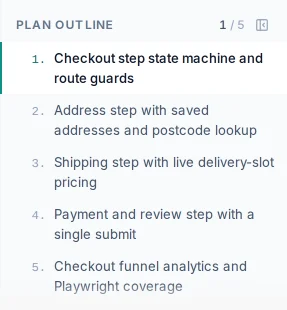
Describe the feature in Planner Studio. Edit the tasks or reshape them in the refinement chat until each one is a PR you would review.
Create N GitHub Issues files one issue per task.

Approve the plan once. ProPR files one issue per task, runs them in order, and carries each pull request through review into an epic branch. You review and merge one epic PR into main.
Describe the feature in Planner Studio. Edit the tasks or reshape them in the refinement chat until each one is a PR you would review.
Create N GitHub Issues files one issue per task.
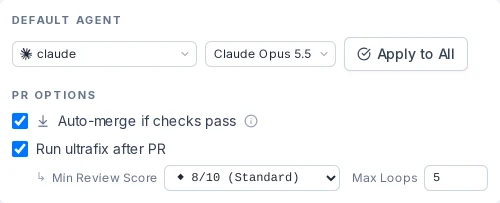
Choose Execute as Epic PR. Turn on Run ultrafix after PR with a minimum score, and Auto-merge if checks pass.
Every issue gets the auto-merge label, and every PR targets the plan's epic branch.
The queue starts the first issue. The next one starts only after the previous PR merges, so each task builds on merged work. On the real run, every PR targeted 2888-epic-task-assignment-1m4.
Each PR loops through review, fix, and re-review until it reaches the score. ProPR then checks the repository's auto-merge policy and arms GitHub auto-merge into the epic branch. If the repository disallows auto-merge, or the PR has no CI, ProPR merges it directly once the same gates pass. When the policy declines, for example on a protected path, ProPR comments on the PR and the queue waits until you merge it.
The Ultrafix playbook walks through one loop.
ProPR opens one epic PR into main that lists every issue, and keeps a single progress comment current as child PRs merge. When the last one lands, it posts Epic ready for final merge.
Review the whole feature there. /merge brings in the latest main, /review reads the combined diff, and you press merge.
The task-assignment plan on public integry/propr became issues #2888 to #2903. Claude Opus 5.5 implemented each one. All sixteen PRs ran Ultrafix and finished at 8/10 or higher; eleven started at 6/10. ProPR merged thirteen into the epic branch, and the maintainer merged the other three. The maintainer then reviewed, refined, and merged epic #2905 into main.
#2934 starts Ultrafix from the plan's settings

Review 6/10, one fix, re-review 9/10

ProPR merges it into the epic branch

A feature split into reviewed pull requests, each merged into one epic branch at the score you set, and a single epic PR into main that you merge.
/review astra fable